


Next


Sometimes the answer is yes. Often, it's not. A website redesign is an expensive investment financially and in founder attention, especially for startups. If the question concerns a muddled value proposition, a new design only presents that muddle more beautifully.
Instead of us pitching you a project, we want to give you the frameworks we use to score your site and decide if you need a fix, a rebuild, or neither.
This question rarely comes out of nowhere. There are three common inflection points that prompt it, and each has a different “redesign” solution:
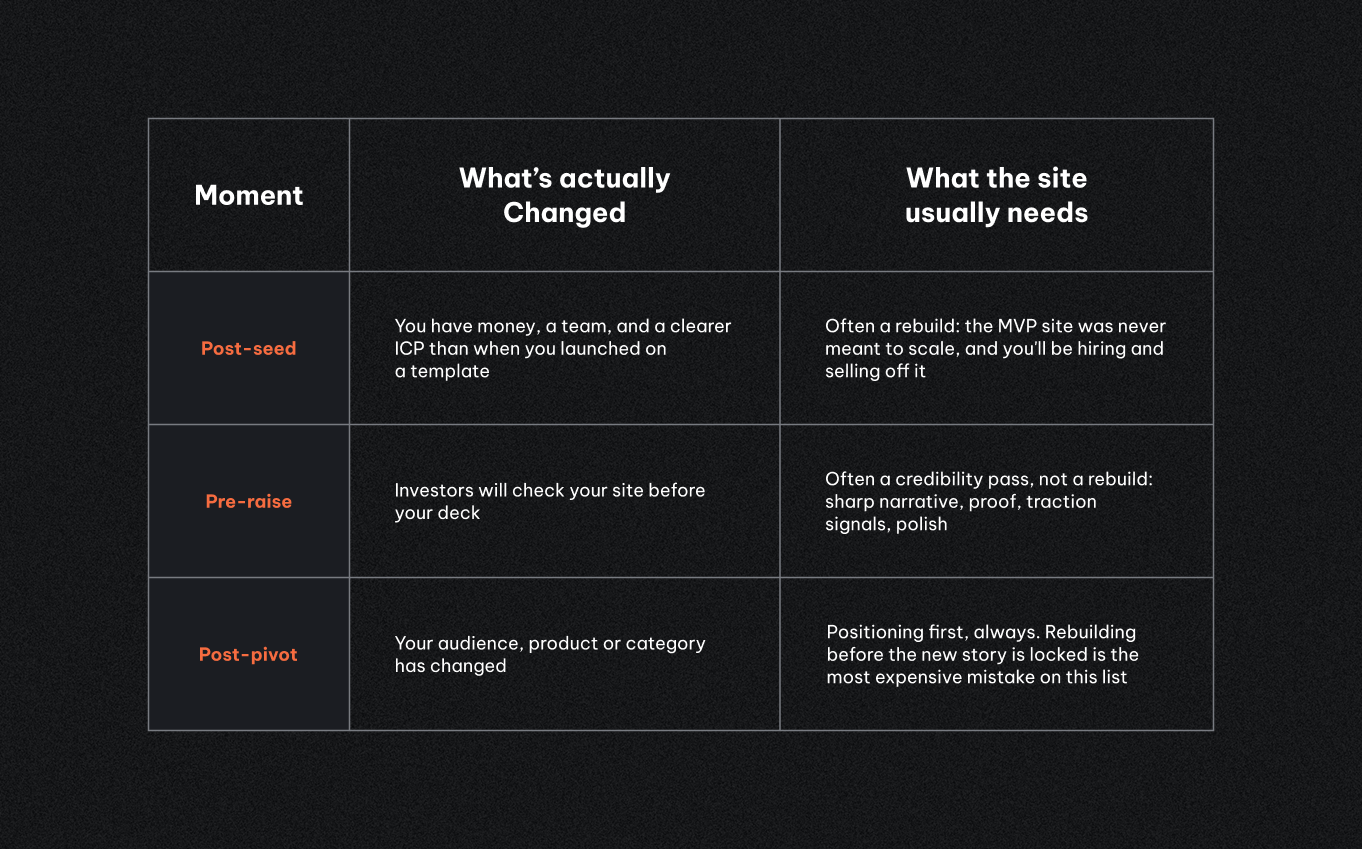
If the website is for fundraising in particular, investors usually spend just a few seconds on the homepage before deciding to be involved or not. They are looking for three things: is the problem concise, does this company look credible, and is there evidence of momentum. This homepage rework, if necessary, is quick, more direct, and more affordable.
There is a four-layer cause stack that can be used as the higher-level, preliminary diagnosis for why a website is underperforming. Each layer in this stack makes every layer about underperform; therefore, the best approach is fixing from the bottom up.
Usually founders are sitting at layer 1 or 2, but assume they’re at layer 4 and commission an entire rebuild that, half a year down the line, converts about the same.
Sometimes the issue is unexpected, especially once we pass layers 1 and 2. At Funtown, we had a long-standing client whose site had no design issues, but their marketing team struggled to launch pages without requiring our developmental support. The site looked the part, but the problem was that the site hadn’t grown alongside the team that was using it. This was one of the projects that urged us to evolve how we diagnose websites. The real auditing question became “what can your team do with the site” rather than solely “how does the site look.”
Run through the statements and score each honestly:
0 = not true
1 = partially true
2 = very true
Total each layer out at 8. Better yet, have someone outside of the company score your website as well.
Any layer that scores 5 or more is your problem layer. Work down the score tree and pause at the first yes.
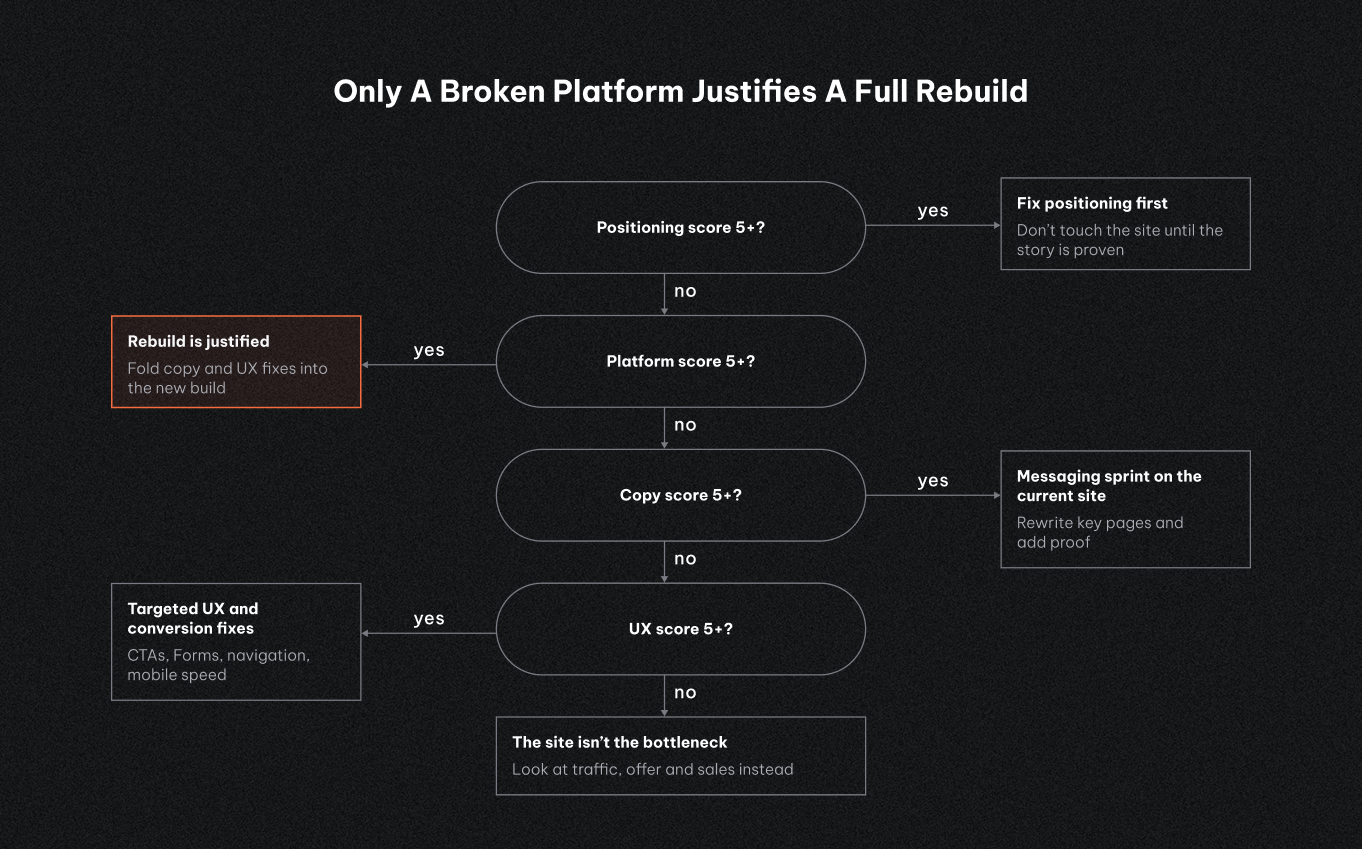
Positioning first because a rebuild cannot fix a story with no clear path. Platform second because you may as well fix copy and UX if you are rebuilding anyways.
A rebuild that doesn’t move numbers is bad for us as well as the founders. We would therefore recommend against a full redesign when:
The points above aren’t necessarily firm cut-offs because, in reality, our job is to investigate further than the surface level reasons for or against a site rebuild.
As a unique instance, a client once came to us with their site expressing a misalignment between its functionality and their current business needs. As their business grew, their original site just could not support their growing business needs. The website was more complex than ever and partially out-of-date, which was dragging down performance. A full rebuild was an option, but it would have been quite the undertaking financially and taken time that wasn’t in the cards. So the approach of a full redesign felt wasteful, since the existing site was still doing its job.
Instead of starting from scratch, our decided approach was to “rebuild” the site page-by-page, but within the existing site. Ultimately, upgrading only the necessary pages and removing what had been depreciated but still hidden within the system. We prioritized the pages that were under the most pressure, and then continued working through the rest on a by-business-need basis. This meant the site was still functional during the rebuild, the client received the required updates sooner, money and time were saved, and all new rebuilds were built to scale from the start.
This doesn’t mean do everything in your power to avoid the rebuild entirely. What we are trying to say is: founders deciding on a rebuild need to start with a strong, clear diagnosis on what the issues are with your website first. Know what to fix before going in and fixing it. Make the redesign (if any) optimal for your website and your company growth.
Related blogs
