.svg)


Next


Picture this: it’s crunch time. The deadline is today, all hands are on deck, and you and your co-developers have to work together to get the Webflow project over the line. There is one page left to finalize. It’s too much work for one developer, but Webflow doesn’t allow multiple developers to work on the same page, at the same time.

As of July 17, 2026, this is no longer a limitation for Webflow Enterprise teams. Now, it is possible for multiple developers to access and edit one page, at the same time, without being kicked out or overriding one another’s changes, with the use of real-time, collaborative branches. Think Github: developers can work in isolation on the same branch, after which work can be merged and published without any oversights or overrides, or without affecting the live site.
If you are reading this as a developer, a designer, or as any member of a production team, you know how stressful it can be working in a time crunch and realizing a fatal (for lack of a better term) mistake has been made, taking the site from almost done to actually broken. Eliminating this risk factor gives developers the peace of mind to work alongside each other more efficiently and calmly, improving the quality of the final product as well as the general work experience in Webflow.
What actually changed? To put it simply, multiple developers can now edit the same branch of a website at once, instead of separate branches that run in parallel. This is a feature that contributes to any part of the development process, not just in times of pre-publishing emergency. If your team has more than one developer, this feature changes the game for you. The safeguards Webflow originally offered that made branching reliable have not changed: there is one branch per page, edits are protected upon merging and publishing, and there is only one active review at a time. This is all maintained, but now multiple people can stand within these guardrails.
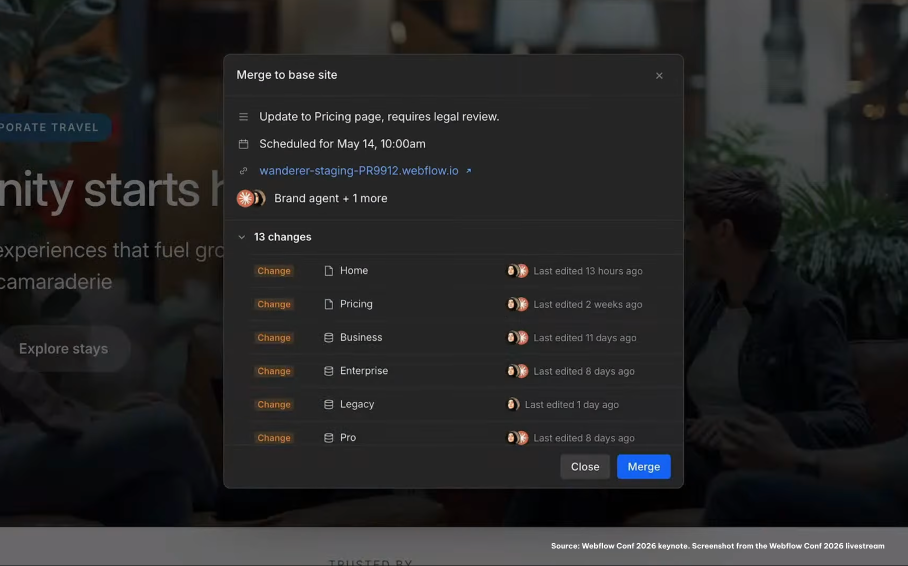
For a production team, this means closer and parallel collaboration, fewer handoffs, and less “wait, who touched this last” moments. There is less room for surprises, and more room for total oversight. It is worth repeating that this is an Enterprise-only update, meaning it might not be worth getting excited about if your team is self-served or on a lower-tiered plan. However, on the other side of the coin, it might be more reason to consider upgrading as your team scales.
In the Funtown team, our workflow has been riddled with a built-in-wait period. In general, the flow is: design hands off to development, development executes the design, and then it goes back to design for review, and then review iterations begin. Now, with this Webflow real-time-collaboration update, and especially in times of urgency, design can step in at the same time and flesh out the finer details in parallel, and the design review can happen live when needed, instead of having to toggle handoffs. The real win here is fewer round trips, as the exchange between our design and development teams essentially becomes more of a conversation.

Webflow came up with a way to answer the “who broke it” question. Now, real-time collaboration on branching solves the “who’s waiting on who” issue, bridging the gaps to speed up the development process while maintaining the standards that both Webflow and your team aim to uphold.
If you would like to learn more about this new feature, take a look at this article for the information, straight from the source.
Related blogs
